Did you know that 397 people in Maine filed fraud complaints for losses totaling more than $7.1 million in 2023, according to the FBI? And that’s just the ones who actually filed, so there are probably many more, and lots of them are seniors.
Now there’s a new program to help people (seniors especially) be more aware of fraud and scam “opportunities”. The Maine Rx Elder Fraud Program is a collaborative effort between the U.S. Attorney’s Office, AARP Maine and the Maine Council for Elder Abuse Prevention. The program, which is designed to educate Mainers on common signs of scams and how to report elder fraud, will begin at Hannaford Supermarkets’ 60 in-store pharmacies across Maine. Informational brochures will be attached to prescription bags for distribution to Hannaford pharmacy customers.
The informational materials were created by the U.S. Attorney’s Office with assistance from the Maine Council for Elder Abuse Prevention. The materials include common signs of scams as well as information about the National Elder Fraud Hotline.
The scam I have noticed most frequently: “update” notices from my email provider, credit card company or phone company. Some are filled with red-flag errors, but others are pretty convincing EXCEPT they come from an obviously wrong email. Your credit card company is not going to email you from a gmail account. Make triple sure that you are dealing with the genuine company before you answer any emails.
New Ventures Maine, a statewide program of the University of Maine at Augusta that has helped Maine residents venture in new directions for over 40 years through tuition-free programs for career, business, and financial education, has announced its next set of fall classes and workshops. Offered at no cost to all Maine adults, the program includes in-person and online options as well as one-on-one coaching. They offer one-day programs and course-length classes that encourage and empower those thinking about making a change to take the next step towards financial security, a new career or even a new business. With topics ranging from job searches, resume strategies and money management to career choices, interviewing and building confidence, the classes and workshops are easy to enroll in and some can even be taken at your own pace. For more information about course offerings and how to sign up, as well as success stories and other resources, please visit their website.
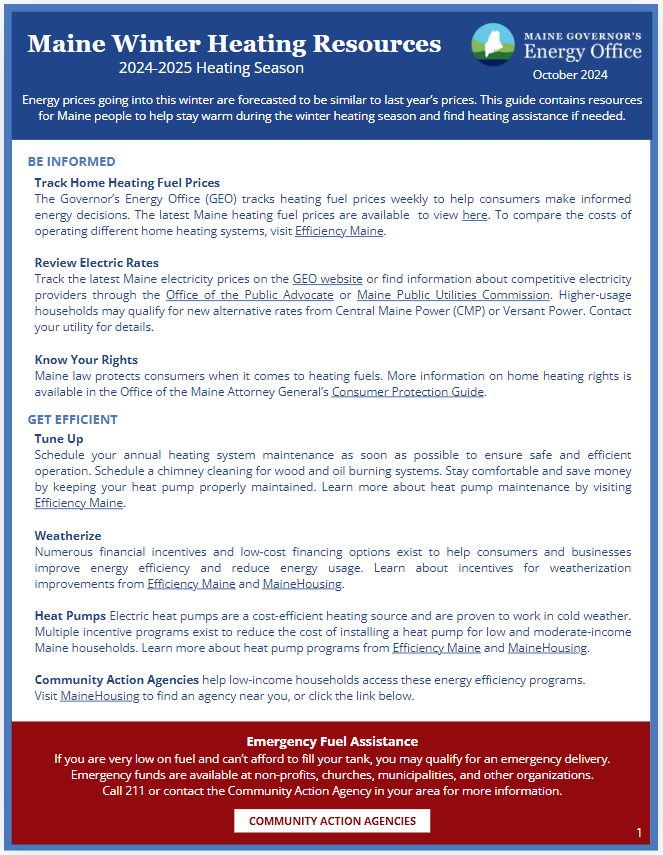
The Home Energy Assistance Program (HEAP) helps qualified homeowners and renters pay for heating costs. Benefits include help paying for fuel and emergency fuel delivery. You can also qualify for energy-related repairs if you are eligible for HEAP.
Households are encouraged to apply for HEAP as early as possible. The application process involves both an application and an interview, to help determine eligibility and the level of benefit. The amount of benefit eligible households receive varies depending on household size, income and other factors.
Applying For The Program
Eligibility
Click here to see if you meet the basic program income guidelines.
Apply
This program will begin taking applications for the 2024-2025 season on July 22, 2024.
Applications for the HEAP Program are handled by your local Community Action Agency and ProsperityME. An online application portal will be coming soon! If you would like to apply before the online application portal is available, please find your local Community Action Agency by entering your zip code in the field below or view all HEAP Agency Contacts here.
Current Zipcode: Find My Agency
Prepare For Your Appointment
You will need to provide copies of certain documents to apply. This list may not include everything so make sure you ask your CAA what to bring.
Names and social security numbers of all people living in your household.
Proof of gross household income for the last 30 day/1 month or 12 months. (Household income includes, but is not limited to: wages, social security, unemployment, pension, and disability payments.)
Proof of present address (for example, a rent receipt, lease, deed, or property tax bill).
Recent copies of your energy and utility bills.
The type of fuel used to heat your home (natural gas, heating oil, propane, wood, wood pellets, biobricks, coal, corn, kerosene or electricity).
Your application will not be processed until all of the requested documentation is provided.
You Have Applied – Now What?
CAA Follow Up
After your appointment the CAA will review your application to determine if you are eligible for a benefit. In most cases the, once eligibility is determined, the CAA will work directly with your fuel provider and the benefit will be paid as a credit to your account.
Emergency Assistance
More help may be available if you have less than a seven (7) day supply of heating fuel. We may also be able to help if you cannot pay your bill and your services may be disconnected. We also be able to help with past due utility bills.
Additional Resources
If you are eligible for HEAP, you also may qualify for other programs that require HEAP eligibility:
If you receive residential electric service from an electric utility and you are not living in government subsidized housing, you may be eligible for assistance with your electric bills from your electric utility’s Low Income Assistance Plan (LIAP).
If your home is not as energy efficient as it could be, you may qualify for home weatherization improvements through our Weatherization Program.
Impostor scams were the most common form of consumer fraud in 2023, according to federal authorities. Many of these attacks involve criminals pretending to be bank fraud investigators, who first send a text questioning certain account activity. Read on to see how this plays out.
How It Works• You receive a text message that appears to be from the bank you do business with, asking for confirmation that recent activity on your account was legitimate.•When you reply “no,” you receive a call, ostensibly from your bank’s “fraud investigations unit,” informing you your account is actively being hacked.•They assure you they can help protect your assets, and you comply, given that the earlier text message appeared to be from your bank and the caller shared specific information that only your bank would know.
What You Should Know• Anytime you get an immediate call from your bank following a text like this, it is a fraud attempt. This is because the transaction noted in the text message isn’t identified by a human — it is identified through machine learning, algorithms, and other bank fraud controls.•It seems so real because the criminals have information about you and your account, which they may have bought from other hackers or accessed through data breaches.•When the criminals convince you there is an active attack and to move the money to protect it, they are actually siphoning those assets.•This crime can wipe out bank accounts, and because it happened through deception, the bank is not responsible for making the victim whole.
What You Should Do• Do not engage with a call from your “bank” following a text questioning an account transaction.•If you are concerned, contact your bank in a way you know to be valid — using a number on a recent statement or by logging in to your online account or app access.•If this happens to you or a loved one, contact your bank immediately upon realizing it to see if they can halt the transaction.•Report it to local or federal law enforcement; even if they do not investigate, this is your proof in the event future compensation is available to victims.
Medicare provides millions of beneficiaries with access to needed durable medical equipment. However, when someone reaches out offering free medical equipment on behalf of Medicare, it’s often a fraud attempt.
How It Works• You receive an unsolicited call or other communication from someone claiming to be a Medicare representative.•They offer you a free medical device or testing, such as a back or knee brace or DNA testing for chronic diseases.•If you decline, the caller may warn that if you don’t accept the offer, you will lose the right to receive the benefit.•The caller will ask you for your Medicare number to process the benefit. What You Should Know• Medicare will not reach out to you unless you have an issue that you are working through with the agency.•Only Medicare beneficiaries’ health care providers can prescribe medical equipment or testing. If someone other than your provider offers you these resources, they are trying to deceive you.•Fraud criminals who get people to accept “free” equipment or testing illegally bill Medicare for services never received, or they sell their victims’ personal information to someone who will use it to get medical care in the victim’s name. This could wreak havoc on your Medicare records. What You Should Do• If someone contacts you claiming to be from Medicare and offering you free medical equipment or testing, disengage. It is fraudulent.•If you need medical equipment or a prescription, talk to your doctor.•Provide your Medicare number only to trusted, personal health care providers and only when necessary.•Carefully review your Medicare Summary Notice or Explanation of Benefits for any unexpected services, tests or equipment.•Contact your provider if you see unexpected charges. If you suspect fraud, call 800-MEDICARE (800-633-4227) to report it.
How It Works• You stumble onto a travel booking site that offers exclusive vacation deals, often for far below market value.•You find a posting for a luxurious vacation rental listing at a lower-than-expected price.•Your rental car search lands you on what appears to be the jackpot — a site offering fantastic deals.•You’re using a popular vacation rental app, and the host asks you to pay upfront and through a means that is off the platform. What You Should Know• Criminals create bogus travel sites that mimic legitimate ones and often appear toward the top of your search because they’ve bought paid promotions.•Scammers also use fake vacation rental listings that are often stolen from real listings and then altered. An unusually low price could be a sign that a listing is not legitimate.•Shady rental car sites may look like those of real companies, but the deals are fake. The thieves who set them up will simply take your money and then disappear.•A host who asks you to pay for your rental home outside of the app is not someone you want to do business with. What You Should Do• Be skeptical of any pitch that offers steep discounts on travel and accommodations.•Vet travel reservation sites before you book. Conduct a web search on the company name (along with the word “scam” or “complaint” or “review”) to read about other people’s experiences.•When renting a car online, type in the web address rather than using a search engine. This will reduce the chance of accidentally landing on a look-alike site.•Pay for travel reservations and bookings with a credit card, which offers greater protection than other forms of payment.•When using a vacation rental app, be suspicious if the host wants you to pay off-platform. For example, Airbnb only allows this for certain fees (such as local taxes), and VRBO states that payments outside its checkout form are not eligible for its “Book with Confidence” guarantee.
Imagine you’re browsing the internet when out of nowhere, a message pops up accompanied by a blaring sound warning you that your device is infected with a virus. This happened to Helen, a retiree in her 80s. Panicked by the warning, she followed on-screen instructions and phoned the tech support number provided. The criminals pretending to be tech support inevitably stole nearly all of her life savings.
Sadly, Helen’s story is far too common. This tech support scam has been around a long time, but technological advances and new twists have allowed the crime to flourish. Here’s what to know to protect yourself and your loved ones.
How It Works• A pop-up notice, often accompanied by a blaring siren-like sound, claims there’s something wrong with your device.•The maddening sound doesn’t stop, and the page won’t close.•The pop-up includes a toll-free number, which it claims will connect you to tech support associated with a big name such as Microsoft or Norton.•Tech support impostors say they require remote access to the device to detect the problems.•That’s where things can go very wrong. What You Should Know• A version of this fraud attack convinces the target to pay to fix the problem and pay more to enroll in a nonexistent support plan.•In a newer twist, criminals use remote access to plant login-stealing malware designed to expose your usernames and passwords to all of your accounts, including financial ones.•More complex fraud attacks begin with tech support, then evolve into bank and government impersonation schemes that end with criminals wiping out the victim’s financial accounts. What You Should Do• If this happens to you or a loved one, contact your financial institution immediately to see if it can stop the flow of funds, then report the crime to the police so you have a record of it in case there is restitution.•If you get a pop-up that won’t close, shut down your device (on a laptop, hold the power button down until the computer shuts off).•When prompted to update your operating systems and antivirus software, do it right away, or better yet, set them to automatically update. These updates may address vulnerabilities.•If you suspect an issue with your device, take it to a big-box store that offers tech support or to a trusted technician.
Summer is the prime season for moving. Whether you’re relocating across the country for work, downsizing to a new home or sending a kid off to college, choosing the right moving company should be at the top of your to-do list.
Placing your trust in a company to transport your belongings safely and securely at the agreed-upon price is a significant commitment, and unfortunately, scammers often exploit the stress and anxiety of moving.
Here’s what to know to protect you and your possessions from a costly moving scam.
How It Works• You see enticing ads for cheap moving options online or in print.•The “affordable” mover offers you an estimate by phone without coming to assess the work effort.•They might demand a hefty deposit, or even full payment, in advance.•The mover may ask you to sign a blank or incomplete form, saying they’ll fill it in later. What You Should Know• Moving scams are committed by rogue operators that exist primarily online.•With your deposit in hand, the “movers” may simply not show up at the appointed time and place.•Or they’ll try to change the deal at the last minute, jacking up the price or adding fees, which can double the cost of your move.•In the worst case, the movers might disappear with your stuff, abandon it in a storage facility or refuse to deliver unless you fork over more money, a scenario known as a “hostage load. ”What You Should Do• Get referrals from relatives, friends or neighbors who have moved recently or from real estate agents.•Research companies you are considering. Look up their Better Business Bureau profiles, and use the Federal Motor Carrier Safety Administration’s database to review an interstate mover’s registration status and complaint history.•Get everything in writing — including estimates. If there are any changes, insist on a revised estimate before any packing or loading begins.•Use a credit card when paying so you have its protection in the event of a dispute.
The Maine Public Utilities Commission (PUC) approved new rates beginning in July to reflect increases in distribution and transmission rates for customers of Maine’s electric utilities. Some of the increase was the result of storm damage incurred over the past two years. The PUC also approved an increase in the stranded cost portion of electric bills to recover solar project subsidies and program costs of the Net Energy Billing program. On average, the new increases will cost ratepayers between $10-$17 per month, depending upon your provider. Several programs are available to assist qualifying residents with their electricity bills. Two such programs are the Low-Income Energy Assistance Program (LiHEAP), administered by the Maine Housing Authority (MaineHousing), and the PUC’s Low-Income Assistance Program (LIAP). Applications for both LiHEAP and LIAP are administered by your local Community Action Partner (CAP) agency. You can apply for energy assistance beginning in July for the 2024-2025 season at your local CAP office found here. Visit MaineHousing’s website for more information about the application process. Another program to aid those who are behind or “in arrears” with their electricity bill is the Arrearage Management Program (AMP), which can help reduce the past due balance. This program is also administered by the local CAP agencies. For a complete list of energy and heating assistance programs available, visit the Public Utilities Commission’s website.
The Rainy Day Savings Account (RDSA) Program offers a matched savings account for income-eligible individuals and families who want to save money to pay for unexpected emergency expenses. This program matches each dollar you deposit in your RDSA, up to $400, with $1 from private donors.
The Family Development Account encourages income-eligible working adults to save for a major purchase. Please contact your local NVME office for details and to apply.