Create a Living Will

Ways to Create a Living Will

Posted On 16 Jul 2015

By : Jeff Anderson


Most Americans understand the basics of living wills. We understand that they are binding documents to specify our medical wishes if we can’t communicate because of illness or injury. We also realize that they address such questions as whether we want life extending treatment while terminally ill or in a permanent coma.

Though, many of us need assistance creating a living will. Learn more about how to create your own.

Create a Living Will

According to a recent poll, 42% of American adults have living wills, which is a vast improvement over the mere 17% of American adults who had living wills in 1991. But, 42% is not good enough. Healthcare experts say all adults ought to have a living will, including some prominent advocates we featured on our blog, such as Nathan Kottkamp, founder of National Health Care Decisions Day, and Paul Malley of Aging with Dignity.

If you have older parents, there’s a good chance they have already completed a living will. While for all adults, living will adoption is 42%, more than half of seniors have taken this step, according to an ABC News poll.

If you’re not sure whether your parent has a living will, simply ask. It’s among the most important questions to ask an older loved one when verifying she or he has made satisfactory plans for potential long-term care and end-of-life care needs. Older parents who don’t have a living will usually agree to create one when they are approached about it in a kind and sensitive manner. But some parents will resist for various reasons.

A great way to get your parent or loved one to complete a living will is to complete yours first, or even complete a living will with your parent. You could say something like:

“Mom, I’m making a living will now and I think you should too. It’s not because I think you won’t be around long. It’s just the right thing to do.”

This approach shows parents we aren’t necessarily asking them to create a living because we’re worried about their health. It could be seen as hypocritical to ask your parent to complete living will without being willing to take that same step yourself.

Ensuring Your Living Will is Legally Valid

Living wills involve more than merely writing your wishes on a notepad and putting them in a safe place.

Living wills are legal documents. To make sure your living will is honored, use the appropriate documents for your state, complete them properly, and file them with the right local authority.

To make sure you get the right documents, use the links below, which feature some of the best websites with free, downloadable and state-specific living wills.

State-Specific Living Will Downloads

Several excellent websites provide free, state-specific legal documents with clear instructions that can be downloaded and used to create a valid living will anywhere in the U.S:

Another great resource is the Five Wishes living will from Aging with Dignity, which is valid in 43 of 50 states.

Making Sense of Living Wills

Before completing any forms, you may want to familiarize yourself with the basic of living wills and associated documents like power of attorney for health care.

Unfortunately, the terminology of living wills can be a bit confusing. This is is largely a consequence of living in a nation with 50 semi-sovereign states  that have their own legal systems.

Some states simply call a living will a living will, but others have inexplicably wordy and idiosyncratic terms. For example, depending on your state, the  living will document may have various official names including:

  • Declaration
  • Health Care Directive
  • Directive to Physicians and Family or Surrogates
  • Instructional Directive

Living Will Requirements and Terminology in Your State

To help you quickly understand the requirements and terminology in your state, read these simple definitions of the most standard terms for the three main documents related to your healthcare wishes.

You can then refer to the alphabetical list of states below to see what this document is officially called in your state:

  1. Living Will: A document that expresses your healthcare and end-of-life care wishes.
  2. Power of Attorney for Health Care: A document naming a person to help assure your healthcare issues are honored and with authority to make medical decisions for you in areas where your wishes are unspecified or unclear. This person is called a “health care proxy,” “agent,” or “surrogate.”
  3. Advance Directive: A document that combines the powers of a living will and power of attorney for health care.

Some states require two documents: both a living will and a power of attorney for health care, which complement one another. Other states have simplified the process by using an advance directive, whichcombines the living will and power of attorney for health care. In other words, some states use a one-document system and others use a two-document system:

  • One-document system: A single document specifies your wishes and also empowers a health care proxy
  • Two-document system: Separate documents specify healthcare wishes and empower a health care proxy

A few states accommodate both methods. In these states, it is probably simpler to use the one-document options, but there may be circumstances in which a two-document approach is preferable.

Finding the Number of Documents Required in Your State

Using the definitions above as a starting point to assure mutual understanding, the list of states below provides each state’s particular (and sometimes peculiar) living will terms. The number of terms defined also indicates the number of documents required:

  • In states that use the one-document system, one term is defined
  • In states with the two-document system have two terms defined
  • In the states where both methods are accommodated, we provide the state’s official term for advance directive in addition to the state’s terms for living will and durable power of attorney for healthcare

Living Will Related Terms in the 50 States and D.C.

  • Alabama: Living Will =  Advance Directive for Health Care
  • Alaska: Living Will = Advance Health Care Directive
  • Arizona: Living Will = Living Will | Durable Power of Attorney for Health Care =  Durable Power of Attorney for Health Care
  • Arkansas: Living Will = Living Will | Durable Power of Attorney for Health Care = Durable Power of Attorney for Health Care
  • California: Living Will = Advance Health Care Directive
  • Colorado: Living Will = Declaration as to Medical or Surgical Treatment | Durable Power of Attorney for Health Care =  Medical Durable Power of Attorney
  • Connecticut: Living Will = Document Concerning Health Care and With­holding or Withdrawal of Life Support Systems | Durable Power of Attorney for Health Care = Appointment of Health Care Representative | Advance Directive (one-document alternative) =  Health Care Instructions and Appointment of Health Care Representative
  • Delaware: Living Will = Advance Health Care Directive
  • District of Columbia: Living Will = Declaration | Durable Power of Attorney for Health Care = Durable Power of Attorney for Health Care
  • Florida: Living Will = Living Will | Durable Power of Attorney for Health Care = Designation of Health Care Surrogate
  • Georgia: Living Will =  Advance Directive for Health Care
  • Hawaii: Living Will =  Advance Health Care Directive
  • Idaho: Living Will: Living Will and Durable Power of Attorney for Health Care
  • Illinois Living Will = Declaration | Durable Power of Attorney for Health Care = Durable Power of Attorney for Health Care (Healthcare instructions can be made on the form designating a Durable Power of Attorney for Healthcare document, which provides a one-document option)
  • Indiana Living Will = Living Will Declaration | Durable Power of Attorney for Health Care = Durable Power of Attorney for Health Care and Appointment of Health Care Representative
  • Iowa: Living Will = Declaration | Durable Power of Attorney for Health Care = Durable Power of Attorney for Health Care
  • Kansas: Living Will = Declaration | Durable Power of Attorney for Health Care = Durable Power of Attorney for Health Care Decisions
  • Kentucky: Living Will = Advance Directive
  • Louisiana: Living Will = Living Will Declaration
  • Maine: Living Will = Advance Health Care Directive
  • Maryland: Living Will = Advance Directive
  • Massachusetts: Living Will = Document Directing Health Care| Durable Power of Attorney for Health Care =Health Care Proxy
  • Michigan: Living Will = Document Directing Health Care | Durable Power of Attorney for Health Care =Patient Advocate Designation
  • Minnesota: Living Will = Health Care Directive
  • Mississippi: Living Will = Advance Health Care Directive
  • Missouri: Living Will: Declaration | Durable Power of Attorney for Health Care = Durable Power of Attorney for Health Care
  • Montana: Living Will: Declaration | Durable Power of Attorney for Health Care = Durable Power of Attorney for Health Care
  • Nebraska: Living Will: Declaration | Durable Power of Attorney for Health Care = Durable Power of Attorney for Health Care
  • Nevada: Living Will: Declaration | Durable Power of Attorney for Health Care = Durable Power of Attorney for Health Care Decisions
  • New Hampshire: Living Will = Advance Directive
  • New Jersey: Living Will= Instruction Directive | Durable Power of Attorney for Health Care = Proxy Directive| Advance Directive (one-document alternative) = Combined Advance Directive for Health Care
  • New Mexico: Living Will = Advance Health Care Directive
  • New York: Living Will = Document Directing Health Care | Durable Power of Attorney for Health Care =Health Care Proxy
  • North Carolina: Living Will = Advance Directive| Durable Power of Attorney for Health Care = Health Care Power of Attorney
  • North Dakota: Living Will = Health Care Directive
  • Ohio: Living Will = Durable Power of Attorney for Health Care
  • Oklahoma: Living Will = Advance Directive for Health Care
  • Oregon: Living Will = Advance Directive
  • Pennsylvania: Living Will: Living Will | Durable Power of Attorney for Health Care: Health Care Power of Attorney|
  • Rhode Island: Living Will: Declaration | Durable Power of Attorney for Health Care: Durable Power of Attorney for Health Care
  • South Carolina: Living Will: Declaration | Durable Power of Attorney for Health Care: Health Care Power of Attorney (Healthcare instructions can be included with Health Care Power of Attorney document, which provides a one-document option)
  • South Dakota: Living Will = Living Will Declaration | Durable Power of Attorney for Health Care = Durable Power of Attorney for Health Care
  • Tennessee: Living Will= Advance Health Care Directive
  • Texas: Living Will = Directive to Physicians and Family or Surrogates | Durable Power of Attorney for Health Care= Medical Power of Attorney
  • Utah: Living Will = Advance Health Care Directive
  • Vermont: Living Will= Advance Directive
  • Virginia: Living Will = Advance Medical Directive
  • Washington: Living Will = Health Care Directive| Durable Power of Attorney for Health Care = Durable Power of Attorney for Health Care
  • West Virginia: Living Will = Living Will | Durable Power of Attorney for Health Care = Medical Power of Attorney
  • Wisconsin:Living Will = Declaration to Physicians| Durable Power of Attorney for Health Care = Power of Attorney for Health Care
  • Wyoming: Living Will = Advance Health Care Directive

(The state terminology is sourced from attorney Betsy Simmons Hannibal.)

Additional Living Will Resources

  • Aging With Dignity –  Website of organization that created Five Wishes, which includes information, resources and support to help people make their wishes known and assure they are respected
  • National Health Care Decisions Day – The website of the annual daily health observance contains valuable information and references for living wills and advance directives
  • Go Wish Cards – “A card game that is a simple way to think and talk about what’s important to individuals and their family members if someone becomes seriously ill”

Reprinted from A Place for Mom


Sample Letter of Instruction

Letter of Instruction

in the Estate of

Name: __________________________________

  1. List of Gifts not listed on the will:

ARTICLE       TO WHOM / RELATIONSHIP

______________________________ ______________________________

______________________________ ______________________________

______________________________ ______________________________

______________________________ ______________________________

______________________________ ______________________________

______________________________ ______________________________

  1. Credit Cards:

Company         Card No.         Exp. Date

__________________________________________________________________________________________________________________________________

___________________________________________________________________________________________________________________________________________________________________________________________________

___________________________________________________________________________________________________________________________________________________________________________________________________

Credit card insurance?___________Amount__________________________

Name of insurance company____________________Policy #____________

III. Bank Accounts and Savings Deposits

Name and Address of Bank Type Account Account Number

_____________________________________________________________________________________________________________________________________________________________________________________________________________________________________________________________________________________________________________________________________

__________________________________________________________________________________________________________________________________

Bonds are located at_____________________________________________

  1. U.S. Bonds

Denomination   Number            In Name Of

___________________________________________________________________________________________________________________________________________________________________________________________________

Bonds are located at_____________________________________________


  1. Stocks, Mutual Funds, and Other Securities

Company Date Purchased Purchase Price Certificate # _______________________________________________________________________________________________________________________________________________________________________________________________________________________________________________________________________________________________________________________________________________________________________________________________________________________________________________________________________

Carried in account number_____________maintained with____________

_________________________________________________________________

Name and address of broker: _____________________________________

_________________________________________________________________

  1. Insurance
  2. I (do)(do not) have government life insurance.

This insurance is (U.S. government life insurance)

(National Service life insurance)

(Servicemen’s group life insurance)

The policy number is____________________________________

Type of insurance _____________________________________

Amount of government insurance___________________________

The policy is located at_________________________________

  1. I have in effect the following commercial life insurance:

Company Address Policy Number Amount

_________________________________________________________

_________________________________________________________

_________________________________________________________

_________________________________________________________

These policies are located at____________________________

The following loans are outstanding against these policies:________________________________________________

_________________________________________________________

_________________________________________________________

  1. Primary beneficiary______________________________________

Contingent beneficiaries_________________________________

  1. Life insurance in effect upon the lives of my wife and children:

Name and relationship Company Policy # Amt Premium Due

_________________________________________________________

_________________________________________________________


  1. The property and casualty insurance policies presently in effect are:

Company City, State Policy # Amount

Personal liability __________ _____________ __________________

______________________________________________________________

Hospitalization

and health __________ _____________ ___________________

______________________________________________________________

VII. Moneys Owed to Me

Amount            Debtor’s Name and Address

________________________________________________________________

________________________________________________________________

________________________________________________________________

________________________________________________________________

VIII. Liabilities (Loans, notes not previously listed)

Amount Lender’s name and address Date Made Date Due

__________________________________________________________________________________________________________________________________ _________________________________________________________________

  1. Safe Deposit Box

Location of box_________________________________________________

Safe deposit box key located at_________________________________

  1. Valuables not listed above:

Item     Location

________________________________________________________________

________________________________________________________________

________________________________________________________________

________________________________________________________________

  1. Other Pertinent Information and Instructions:

_________________________________________________________________

_________________________________________________________________

_________________________________________________________________

XII. This record was last checked on: _________________________

Letter of Instruction: The Most Important Letter You Will Ever Write


“Where is Mom’s Social Security card?” It’s a common refrain when someone can’t help with their own affairs. Confusion and uncertainty compound the difficulties of dealing with a family emergency. There is a way to help those who will have to act in a family emergency. It’s called a “letter of instruction.”

How an Hour Now May Eliminate Uncertainty in Times of Family Emergencies

The letter of instruction is NOT a legal document. It does NOT replace a will or trust, a Health Care Power of Attorney or Living Will, or a Durable Financial Power of Attorney. On the other hand, the letter of instruction offers practical guidance usually not contained in any legal document. It’s a good way to let to those trusted to take care of your affairs know what you would want them to know.

letter of instructionSince the letter of instruction is not a legal document, it does not need to be notarized or signed in the presence of witnesses or with any other special formality.

It is also different than the “Separate Writing” that lawyers sometimes recommend accompany a Will or Revocable Living Trust. That document directs the distribution of your personal property after your death. [For example, Aunt Sally’s watch goes to my daughter Amanda; and Grandpa’s shotgun to Billy.]

Who should write the Letter of Instruction?

A husband and wife should prepare one together. The person who handles the family financial affairs should write one for the person who will have to take over in case of death or incapacity.

When is it used?

A Will is usually not read until some time after the person’s death. The letter of instruction should be readily available and in a place where a family member or other friend can find it in the event of emergency. For example, my family knows ours is in the top left-hand desk drawer in my study.

What’s in the letter?

The letter should give the contact information for the people to be notified in the event of a family emergency, and should also tell the location of all important papers . . . and passwords! It could even spell out personal preference in how various matters are to be handled, including funeral arrangements.

It should contain the specific locations of items mentioned in the letter, such as: “My insurance papers are in my safe deposit box,” or “My Social Security file is in the bottom left-hand drawer of the living room desk.”

Who should have the letter?

You should consider making the letter available to someone outside the household. If you choose to provide a copy to the person who would most likely take over if something happened, you need to remember to send them updates when you change the letter. Mostly, however, it is important that someone be able to find the Letter in the event of an emergency.

Reprinted with permission from Maine Senior Guide.

Protecting Parent’s Home from Medicaid with Life Estate

If a person qualifies to receive Medicaid assistance while in a nursing home, the patient need only contribute their Social Security and other income, then the Medicaid program will pick up the balance of the bill. However, upon the death of the Medicaid patient, the state will want to be reimbursed for every dime it paid to the nursing home on behalf of the patient. In effect, the government has made an interest-free loan and now wants to be repaid!

But how can the estate of the deceased patient repay the state? In order to qualify for Medicaid a person can only have $2,000 of countable assets. So upon their death, they won’t have very much of anything to pay back the state, will they?

The key word above is “countable” assets. Since a home is an exempt (non-countable) asset, a person can indeed own a home (even possibly one that’s worth more than $500,000) and still qualify for Medicaid. However, following the death of the Medicaid recipient, the state will want to be repaid out of the proceeds of a sale of that home.

However, many states only make a claim against the deceased’s “probate” estate. That excludes property that passes to a named survivor automatically by law, such as certain real estate in joint names, joint bank accounts, life insurance policies, etc. So if the house passes outside of probate, then the state is out of luck in these states.

One popular method for avoiding probate of a house is simply to give it to the children outright. But then the parent no longer owns the home. Should a child be sued, divorced or go bankrupt, the house could be lost.

A better solution is to give just a “remainder interest” to the child or children. In other words, the parent continues to own the house so long as they live, and only on the death of the parent will the child come into possession of the house. Meanwhile, because ownership passes automatically to the child, it does not pass under the parent’s will—it is not probated—so the state cannot make a claim against the house (in those states that limit their right to recoup Medicaid payments to probate assets).

This is accomplished by having the parent sign a deed transferring the house to one or more children, while retaining a “life estate.” As owner of the life estate, the parent continues to have full control over and access to the house (although it cannot be sold without the child(ren) joining in on the deed). Importantly, it will continue to be classified as an exempt asset for Medicaid eligibility purposes.

Avoiding the look-back

The signing of such a deed will result in the parent making a gift to the child of the “remainder interest” in the house. The attorney who prepares the deed can calculate the value of the gift (it depends on the age of the parent making the gift). Because of this, it is important that the parent not apply for Medicaid for a period of at least five years to avoid the imposition of a very long penalty period.

Example: Parent, age 80, signs house over to child, retaining a life estate. For a person age 80, a gift of the remainder interest is valued at .56341. Thus, if the house is worth $300,000, the value of the gift will be $300,000 x .56341 = $169,023.

As you can see, this is not something that normally can be done when the parent is already in the nursing home and running out of funds. In order to avoid the imposition of the penalty as a result of the parent signing the life estate deed, they normally will need to wait at least five years to apply for Medicaid. Thus, they should have funds sufficient to cover nursing home expenses for at least that long. However, as an advance-planning technique it offers a great advantage of protecting the most important asset owned by the parent, the family home.

Reprinted from Agingcare.com.

Use caution when making charitable donations

The recent revelations about four cancer charities that have collectively scammed more than $187 from consumers has called for more caution when donating to charities.

Maine Attorney Janet Mills urges Maine consumers to make informed decisions about donations and not succumb to pressures from charities.  Consumers can call the Maine Office of Professional and Occupational Registration at 207-624-8603 or go online at www.pfr.maine.gov/almsonline/almsquery/SearchCompany.aspx to see if the charity and its professional fundraiser are registered.

Mills suggested always examining the organization’s purpose, how it uses its donations and what percentage of every dollar donated will actually go to the charity. ” The law cannot limit the percentage that a professional fundraiser can receive from money raised, but you can choose to give to a charity that  receives and uses more of the donations raised on its charitable mission,” the release stated.

One source of that information can be found at www.guidestar.org.


Evaluate Your Driving Ability

With years of experience behind the wheel, senior drivers likely are among the safest on the road. However, skills and abilities required for safe driving do deteriorate with age. The good news is that a few simple actions often can provide older drivers with years of safe driving.

To learn more about your driving abilities to drive safely, check out the resources below. They range from self-screening exercises to professionally administered assessments and feature a variety of tools that rate everything from driving skills to physical limitations and medical conditions of senior drivers.

Do you know the rules of the road? Test your driving knowledge by taking this brief interactive quiz.

Self-Rating Tool

Learn about your driving skills and habits by answering 15 short questions in a printable online brochure, and receive quick tips for senior drivers. Learn More »

Click on the links from SeniorDriving.AAA.com to take the self rating test for drivers 65 plus.

Discussing Driving with Senior Parents

Maybe it was the last time your parents picked you up at the train station when you came for a holiday visit, and you were alarmed by a change in their driving skills. Or perhaps you’re worried because your parents’ eyesight isn’t what it used to be. Whatever the reason, you know that it might be time to bring up the topic of their driving – but it’s not an easy conversation to have. In fact, a survey from the National Safety Council and Caring.com found that adult children ranked talking to elderly parents about their driving more difficult than talking to them about selling their house or even funeral wishes.

“Many family members and even medical professionals are reluctant to bring up this topic,” said Elizabeth Dugan, Ph.D., associate professor of gerontology at the University of Massachusetts, Boston and author of The Driving Dilemma: The Complete Resource Guide for Older Drivers and their Families. “Driving is so closely tied to a sense of freedom and autonomy.” 

But having this conversation, difficult though it may be, is vitally important. According to the Centers for Disease Control and Prevention (CDC), per mile traveled, fatal crash rates increase starting at age 75 and increase notably after age 80. Alarmingly, an average of 500 elderly adults are injured in the U.S. in car crashes every day. 

How can you know for sure when senior parents should stop driving and that it’s time to broach this sensitive topic? It’s not simply a matter of age; some elderly people can continue driving well into their 80s and others may have their driving compromised much earlier by illness, medication, or factors of aging. The American Association of Retired Persons (AARP) has a helpful list of signs that indicate it may be time to limit or stop driving. The list includes things like frequent “close calls,” getting lost, issues with eyesight, and easily becoming distracted. Once you’ve decided to have the talk, here are some tips for making it comfortable and effective:

    • Take a ride to assess your parent’s driving skills yourself. It’s a great conversation starter. “It can be helpful to take a ride with your parent, and then debrief them afterwards,” recommends Dugan. “You can say, ‘I know this is difficult, but you seem to have trouble making left hand turns.'” Be especially observant about how your parent handles situations involving right-of-way. Studies of crashes involving seniors have found that failure to yield the right-of-way is one of the most common driving errors.


    • Keep your tone respectful and sympathetic. Driving represents autonomy, mobility, and social life. You’re not bringing up this topic to be cruel and take away your parent’s independence. You’re having the discussion because you love your parents and are worried about their health and safety. “You’re not saying, ‘Give me the keys,'” says Dugan, “but ‘I care for you and I want you to be as healthy, mobile and independent as possible. If you can’t drive, then we’ll work together to figure out something else.’ The tone you take can make a big difference.”


    • Provide alternative options. Follow up and help your parents find ways to continue their current activities even if they can’t drive. Perhaps friends and family members can pitch in. In many areas there are public transportation options specifically for seniors. Often church and community groups provide local senior transport too.


    • Get experts involved, if necessary. If your parent seems unreceptive to your message, schedule a medical appointment to see if illness or medication is affecting their driving. Make sure your parent has an annual eye exam. A doctor can also refer your parent to a driving clinic to have his/her skills assessed by a professional.


  • Keep an open, ongoing dialogue. Finally, don’t stop talking after just one conversation. Return to the topic periodically, and continually reassess your parent’s driving. A change in skills behind the wheel doesn’t necessarily mean going from driving anywhere to driving nowhere. A senior driver may be fine with familiar local driving, or driving only during daytime hours. “It’s not one conversation that you have to get right,” says Dugan. “Think about it as a process,” a process with the goal of keeping your parents as active as possible AND as safe as possible.

Reprinted from Liberty Mutual at https://www.libertymutual.com/safe-and-smart-living/blog-posts/talking-to-seniors-about-driving


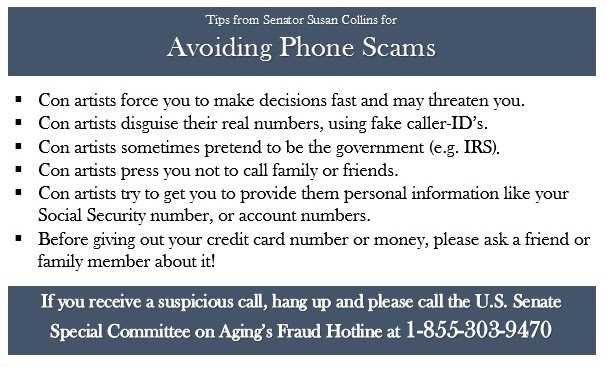
AARP warns of phone scam

The Maine AARP is warning of a new scam in which a caller asks for personal information, including passwords.

The caller claims to be from a company called MCI-ITS S-Telesy.  The caller’s phone number is 213-337-0014, according to the AARP.  The caller asks for computer personal information because of a virus they claim to be monitoring. This company name and phone number have been used in other known scams.

The AARP advised that Maine residents who receive a call from this number should contact the state Attorney General’s Office at  207-626-8800.

Victims of the scam report that the callers have foreign accents, are aggressive on the phone and will call multiple times.

AARP is urging all residents to be aware of this scam and to NEVER give out such personal information such as a Social Security number, credit card number, computer passwords or bank information to unknown sources.

For more information on how to avoid scams, go to aarp.org/fraudwatchnetwork.

5 foods that fight insomnia

A good night’s sleep is one of the keys to more energy and better health. If you can’t fall asleep, or stay asleep – sleep deprivation can lead to physical and mental health issues such as dementia, sundowning and Alzheimer’s disease.  Do you have a senior loved one having trouble getting to sleep? Adding the following foods may help combat their sleeplessness. 

As we age, our sleep patterns may change. According to the National Sleep Foundation, “44% of older persons experience one or more of the nighttime symptoms of insomnia at least a few nights per week or more.”

It’s natural for our senior loved ones to need a little less sleep, or to wake up more during the night. But, if restless nights are causing problems during the day and you can’t attribute it to medication or illness, then you might want to try a little food therapy. A bedtimesnack containing the right nutrients can help seniors – and the rest of us – calm the body, relax the mind and promote better sleep.

Sleep-Promoting Foods for Senior Nutrition

  1. Nutrient-Rich Fruits

Many fruits contain minerals like potassium and magnesium, which help promote sleep by relaxing the muscles and calming the nervous system. Bananas are an excellent choice. Besides being rich in both potassium and magnesium, they also contain tryptophan, an amino acid that helps induce sleep. Tryptophan is converted by the brain into serotonin and melatonin, says the U.S. News and World Report: “Serotonin is a neurotransmitter that promotes relaxation; melatonin is a hormone that promotes sleepiness.”

Cherries are also a rich source of melatonin, and fruits like apples, apricots and peaches contain plenty of magnesium. So, if your loved one is having trouble sleeping – and tends to crave sweets – reach for the fruit bowl.

  1. Complex Carbs

One of our Facebook users also suggested mashed sweet potato with honey as a good bedtime treat. Along with whole grains like oatmeal, popcorn, or even jasmine rice, sweet potato is a good source of complex carbohydrates, which can help increase levels of tryptophan. A small bowl of oatmeal or cereal, whole-grain crackers with a little lean protein (see below), and low-calorie, high-fiber popcorn are good choices. Oatmeal is especially good, says U.S. News, because it also has plenty of calcium, magnesium, phosphorus, silicon and potassium.

  1. Lean Protein

Lean proteins, too, are high in tryptophan, which increases serotonin levels and promotes good sleep. It’s the reason why we all end up in a turkey coma after Thanksgiving dinner. You don’t want to eat too much protein, or anything high in fat or deep-fried, but a dab of peanut butter on a banana, an egg on whole-grain toast, a little low-fat cheese on crackers, or a rice cake with lean turkey or fish can be satisfying and sleep-promoting snacks before bedtime.

  1. Heart-Healthy Fats

It might seem surprising, but heart-healthy fats are another good choice for some nighttime eating. “Unsaturated fats will not only boost your heart health but also improve your serotonin levels,” says the Cleveland Clinic. Think avocados, peanut butter and other nuts. such as walnuts, almonds, cashews and pistachios. Almonds, for instance, are full of protein, as well as magnesium, which promotes muscle relaxation. Just be sure to avoid unhealthy saturated fats and trans fats, which reduce serotonin levels and make sleep more elusive.

  1. Warm Drinks

There’s a reason why mom always recommended that glass of warm milk at bedtime – milk, like other dairy products, contains tryptophan. “Plus, it’s a good source of calcium, which helps regulate the production of melatonin,” says U.S. News. Warm milk with a dash of honey is especially soothing. Decaffeinated herbal teas can also help, particularly relaxing herbs like chamomile or peppermint. Many people drink teas with added valerian root, an herb that has been used for centuries as a natural sedative. Avoid caffeinated beverages, though; even small amounts of caffeine can prevent sleep.

What Not to Eat Before Bed

A quick note on foods to avoid: some edibles (and drinkables) may seem like tempting nighttime treats, but may actually have a negative effect on sleep and rest. Here are a few tips for what NOT to eat before bed:

  • Anything that tends to upset the digestive system, like greasy or spicy foods
  • Eating too much before bed, as it may lead to indigestion and weight gain
  • Eating large amounts of protein, which can be difficult to digest
  • Excessive sweets: “Diets high in refined sugar can cause indigestion and trigger insulin surges that interfere with the hormones that affect sleep,” notes Dr. Oz
  • Don’t drink caffeinated beverages (or eat too much chocolate!) for at least three to eight hours before bed
  • Don’t use alcohol to try to fall asleep as it may initially make you sleepy, but it negatively affects the quality of sleep
  • Limit liquids before going to bed, particularly important for older adults: “It takes about 90 minutes for the body to process liquids, so limit liquids of any kind for at least 90 minutes prior to bedtime if the need to urinate wakes you up in the middle of the night,” suggests nutritionist Joy Bauer on the Today Show

Reprinted from A Place for Mom.


Sleep Problems in the Elderly

It’s National Sleep Awareness Week, and there’s no better time to remind ourselves of how critical sleep is for physical, mental and emotional health — not just for seniors but for caregivers, too.Hard Facts About Sleep Problems in the Elderly

Sleep disorders are a significant source of concern — especially in the geriatric population. Changes in sleep patterns are part of the normal aging process, but sleep disorders have been implicated with increased mortality, and side effects such as dementia, cognitive impairment and falls. This week, the National Sleep Foundation urges everyone to celebrate sleep and its health benefits for National Sleep Awareness Week. We’ve put together an overview of why sleep is critical for senior health, how conditions such as Alzheimer’s disease can change sleep patterns, and what caregivers can do to make sure they get enough rest.

Sleep Deprivation and Insomnia Increase Dementia Risk

We all know a good night’s sleep is the key to feeling energetic and clear-headed the next day, but sleeping soundly is also linked to a lower risk of cognitive impairment later in life. Unfortunately, older adults are more likely to have health issues that disturb their sleep, such as insomnia or sleep apnea. A 2011 study at the University of California, San Francisco, showed a clear association between sleep-disordered breathing in older women and the risk of cognitive impairment.

“Those who developed disruptions of their circadian rhythm were also at increased risk,” reports NPR. “So were those who awoke throughout the night, tossing and turning.”

For seniors who are under some form of psychological stress, this link may be even stronger. Not only does stress affect our sleep patterns, stress in itself has been associated with dementia risk. A study in 2010 found a link between stress in middle-aged women and the later development of dementia, particularly Alzheimer’s.

Dr. Kristine Yaffe, who co-authored the UCSF study, advises older adults to get regularly screened for sleep problems, so that any issues can be caught early and treated before they lead to significant cognitive impairment.

Reprinted from A Place for Mom.