Utility Scams Heat Up During Colder Months

With temperatures dropping in many states, scammers are turning up the heat on their deceptive tactics.
 
While utility scams happen year-round, criminals are especially active when customers rely on these services to stay safe and warm during colder months.
 
Anyone who pays a utility bill can be a target, so here are some things to look for.
How It Works•
You receive an unexpected visit, call, text, or email from someone claiming to be your power or water company.•They might offer a free energy audit or help signing up for government programs to reduce energy bills.•Or they could threaten to cut off service unless you pay an overdue bill or maintenance cost immediately.•They may even claim you’ve overpaid and ask for your bank or credit card information to issue a “refund.”
What You Should Know•
Utility impostors aim to convince you to make a payment to them or supply personal or financial data that they can use to steal or sell your identity. They may open new accounts and run up charges in your name.•Legitimate utility companies don’t request personal information by email or phone and provide advance warning before disconnecting services.•If anyone ever tells you to pay a bill by purchasing gift cards and sharing the numbers off the back, or to go to a bitcoin ATM to send payment that way, it is a scam.
What You Should Do•
It is a sad state of affairs to say not to answer your door when someone unexpectedly knocks and not to trust email messages, text messages, or phone calls, but this is the world we are in.•If a message by any channel immediately puts you into a heightened emotional state — say, fear or panic — let that be your sign to disengage.•Contact your utility company at a number you know to be correct from a paper bill (or log in to their website or app if that’s an option). Don’t do a web search; the results often contain ads bought by criminals to direct customer service calls to them.•If you or a loved one has experienced a utility scam, report it to your actual utility company and to law enforcement. You can also share the information with the Federal Trade Commission online or by calling 87‍7-3‍82-43‍57.

reprinted from AARP Fraud Protection Network

Elder Financial Exploitation

Each year, World Elder Abuse Awareness Day brings international attention to elder abuse, including financial exploitation. The latter includes fraud by known perpetrators (crooked lawyers, the long-lost nephew, etc.) and via scams (what we often call stranger danger).
 
U.S. financial institutions are required to file Suspicious Activity Reports (SARs) to the federal government when they suspect elder financial exploitation. Typically, analyses of these reports have shown the known perpetrator form of exploitation to be more common than scams. That is, until a few months ago.
Do scams outnumber known perpetrators?According to recent analysis by the federal Financial Crimes Enforcement Network (FinCEN), 80 percent of SARs reviewed over a one-year period involved scams, with 20 percent involving known perpetrators.
 
It is uncertain whether stranger danger scams are that much more prevalent than known-perpetrator fraud today, or whether financial institutions are now better at identifying and reporting scams. Either way, it aligns with how people are feeling about scams these days. A recent AARP survey shows that 91 percent of U.S. adults worry about scams. Their top concern? Becoming a victim themselves.Ways to harden the target
The growing recognition that fraud can (and does) happen to anyone, regardless of age or other characteristics, is actually a good thing. Recognizing our potential susceptibility reduces victim shaming and likely increases the desire to find ways to better protect ourselves.
 
Here are steps we can all take to harden the target against scams.
1•Create strong and unique passwords for all online accounts, and enable multifactor authentication where offered (this is a code that adds a second layer of protection as you log in to your accounts).
2•Avoid clicking on links in emails and text messages. If you get an email or text from a company you do business with that suggests a problem with your account, don’t click a link to look into it. Rather, go to the website or app and log in to see if there’s a problem.
3•Only use public Wi-Fi if you have a virtual private network, or VPN, installed on your device. Otherwise, use your cell service if available.
4•Update your device’s operating system and antivirus protections when prompted — better yet, set them to automatically update. These are often used to patch known vulnerabilities.
5•Monitor your credit and consider a credit freeze. The latter helps protect against someone opening an account in your name. (Visit annualcreditreport.com to learn more about both.)
 reprinted from AARP Fraud Protection Network

AI Fuels New, Frighteningly Effective Scams

AI tools can be legitimately useful for many reasons, but they also can be easily weaponized by criminals to create realistic yet bogus voices, websites, videos and other content to perpetrate fraud. Many fear the worst is yet to come. 

We’re entering an “industrial revolution for fraud criminals,” says Kathy Stokes, AARP’s director of fraud prevention programs. AI “opens endless possibilities and, unfortunately, endless victims and losses.”

Criminals are already taking advantage of some of those “endless possibilities.”

Celebrity scams. A “deepfake” (that is, a computer-generated fake version of a person) video circulated showing chef Gordon Ramsay apparently endorsing HexClad cookware. He wasn’t. Later, a similar deepfake featured Taylor Swift touting Le Creuset. The likenesses of Oprah Winfrey, Kelly Clarkson and other celebs have been replicated via AI to sell weight loss supplements.

Fake romance. A Chicago man lost almost $60,000 in a cryptocurrency investment pitched to him by a romance scammer who communicated through what authorities believe was a deepfake video.

Sextortion. The FBI warns that criminals take photos and videos from children’s and adults’ social media feeds and create explicit deepfakes with their images to extort money or sexual favors.

Fighting back — with AI

Governments are scrambling to keep up with the fast-evolving technology. The White House in late 2023 issued an executive order calling for increased federal oversight of AI systems. The technology, it noted, “holds extraordinary potential for both promise and peril.” That led to the establishment of the U.S. AI Safety Institute within the U.S. ­Department of Commerce to “mitigate the risks that come with the development of this generation-defining technology,” as Commerce Secretary Gina Raimondo put it.

As it turns out, AI may be our best tool for countering the malicious use of AI. 

How to protect yourself as AI fuels more sophisticated scams

Don’t trust your caller ID. If you get a call from a business, hang up and find the company’s number (for a bank, it will be on your financial statement, for example), then call directly. No matter what the pitch, anyone asking you to pay with a gift card is a scammer, according to the Federal Trade Commission.

Pause before you click. Never click on a link in an email or text message without confirming that it’s from a legitimate source. Criminals can craft extremely sophisticated-looking messages, as well as fake websites that convincingly mimic real ones.

Consider choosing a safe word for your family. Share it only with family members or others in your inner circle. If someone calls claiming to be a grandchild, for example, you can ask for the safe word or words — rubber ducky, Fred Flintstone, whatever — and if the caller doesn’t know it, it’s clearly a scam.

Call back your “grandchild” in crisis. If you don’t have a safe word and your supposed grandchild or child calls saying there’s a medical emergency or some other crisis (sometimes callers say they’ve been kidnapped), they may add that their phone is broken so you can’t call them. Pause, take a breath (criminals try to rattle you to disrupt your rational thinking), and tell them you want to try to call them back anyway. Chances are your real grandchild will pick up, unharmed and bewildered by your concern.

Don’t click on ads to download software. The FTC says that if you see an ad for software that piques your interest, rather than clicking on a link, go to the company’s website by typing in its address. If you search for it online, the agency warns, “remember that scammers also place ads on search engines. They’ll appear at the top of your search results page and might have a label that says ‘Ad’ or ‘Sponsored.’ Scroll past those to get to your search results.”

Guard your personal information. To avoid identity theft, be careful about disclosing your full name, your home address, your Social Security number, credit card and banking information, and other personal details. Definitely don’t share information with someone you only know from email or texting.

Spread the word. Educate your loved ones on the latest scams and the advice above.

Report scams. If you spot a scam or you’ve been a victim of one, report it to the police, as well as the FTC at reportfraud.ftc.gov. The more information authorities have, the better they can identify patterns, link cases and ultimately catch the criminals.   

Fake Ads, Fake AI

It’s worth playing around with a chatbot to get a sense of the technology’s potential (and it’s kind of fun). But note that cybercriminals advertise AI tools on social media and search engines with links that will download malware on your computer if you click on them, the Federal Trade Commission (FTC) warns.

Some sites are fake, the FTC says, but “some ads actually take you to the real software and download the malware through a ‘backdoor,’ which makes it hard to know you got hacked. Then, the criminals could steal your information and sell it to other hackers on the dark web, or get access to your online accounts and scam others.”

You can also report scams to the AARP Fraud Watch Network Helpline, 877-908-3360. It’s a free resource, with trained fraud specialists who can provide support and guidance on what to do next and how to avoid scams.

Brushing Scam

A recent scam has been showing up in many states. A “brushing” scam is when someone receives an unexpected gift or item not ordered in the mail from a place like Amazon or other company. Examples of gifts include, rings, bracelets, necklaces, Bluetooth speaker, etc. The gift will have the recipient’s address, but not include the sender’s information or be from a known retailer. When the recipient opens the package to see what it is and possibly who sent it, there is a QR code to scan to find out who sent the gift.

Once the code is scanned, all the information from that phone will be sent to scammers. They receive all access to the phone. All personal and financial information is accessible to the scammers and often the victim’s bank accounts are drained.

The gift can be kept or thrown away, but the QR code should NOT be scanned for any reason. QR code scams are nothing new. These scams show up in all places, including parking meters.

Inform your family members about the scam and avoid scanning any unknown QR codes included in the package.

Brushing scams are illegal in the United States and many other countries. If you receive a package you didn’t order, you can:

  • Mark it “Return to Sender” if you haven’t opened it. The Postal Service will return it at no cost.
  • Throw it away if you open it and don’t like it.
  • Keep it if you open it and like it

Rise in Reports of Fake PayPal Invoice Scams
In 2023, PayPal was the third most-impersonated brand reported by consumers, according to the Federal Trade Commission. While phishing attempts using the names of well-known companies are not new, the AARP Fraud Watch Network Helpline has seen a rise in reports of PayPal scams involving cryptocurrency.
 
Here’s a closer look at how some PayPal scams work and steps to safeguard yourself.
How It Works•
You receive an email from PayPal with an invoice for a high-value purchase, such as cryptocurrency or anti-virus software, that you never made.•To dispute the transaction, you’re urged to call the customer service number provided on the invoice.•When you call, you may be asked for personal or payment information to verify your identity and warned that your account has been compromised.
What You Should Know•
Unexpected emails urging you to act fast, click a link or call a number are often phishing scams.•Their goal is to connect you with a spoofed website or fake customer service representative so criminals can steal your personal and financial information, or worse, access information to take over your online accounts, including financial accounts.•Delivery of fake invoices may also come via PayPal’s system, so they appear in the recipient’s PayPal account and email inbox. This makes the scam look more convincing.

What You Should Do

Be cautious of urgent messages claiming to be from PayPal, pressuring you to call quickly to resolve an alleged account issue.

If you receive a suspicious invoice or money request, don’t engage with it in any way.

To report a potentially fraudulent invoice, log in to your PayPal account directly through its verified website or app and use its official customer service channels.

reprinted from AARP Fraud Watch Network


Common Holiday Scams

Card declined scams. This is a new scam criminals have cooked up, according to Melanie McGovern, spokesperson for the Better Business Bureau (BBB). You pay for a purchase online and get a message telling your card has been declined. “The transaction did go through, but they’re trying to get more information out of you,” says McGovern. Entering another card into the system means that you’ll be charged on both cards. 

Charity scamsSham charities exploit Americans’ goodwill during giving season via fake websites and pushy telemarketers.

Online shopping scamsBogus websites and social media campaigns that impersonate major brands. These fake posts and ads entice you to spend money for products you’ll never receive. “We have seen an increase in consumers buying from social media without doing their research. Most social media ads are not vetted,” warns Nofziger. “Be careful when you see an item offered at below market price. If you do click on an ad, make sure it directs you to the page you want to be on. Often times you are directed instead to a 3rd party vendor.”

Gift card scams. “Gift card draining is still very popular,” says Nofziger. This is when criminals steal gift cards in bulk off the racks, collect the information off the card and return it to the in-store rack for unsuspecting buyers. “Once you load money on there, the criminal will drain the money off, even sometimes before you leave the store.” It’s safest to buy cards that are kept behind the counter, or directly from the retailer’s site.

Delivery scams. As holiday packages crisscross the country, scammers send out phishing emails and texts disguised as UPS, FedEx, U.S. Postal Service notifications about incoming or missed deliveries. Links lead to phony sign-in pages asking for personal information, or to sites that may be infested with malware.

Travel scams. Some criminals send scam emails and texts offering travel promotions such as free flights to get you to share credit card information or click on links that download malware. Also be wary of the many spoofed websites pretending to be legitimate hotels, airlines and other travel-related businesses.

Here are ways to make sure your money stays in your wallet.

Go to websites you’ve verified. Rather than clicking on a link from an email or text to a hot deal, go to your web browser and type in the address of the company purportedly offering said great deal.

Pay by credit card. This way you can dispute charges and limit the damage if the transaction was fraudulent.

Buy gifts cards from behind the counter “where more eyes on are on it, save the receipt that shows the time and amount of money loaded,” says Nofziger. “Better yet, consider send an e-gift card that has less possibility of being tampered with by criminals.” And when buying that e-card, be sure to buy from the retailer’s site, not a third-party.

Research requests for donationsCharity Watch, Charity Navigator and GuideStar provide a bevy of resources on charitable organizations, including ratings, reviews and financial information. Pushy charities could be an indicator that the cause is bogus; legitimate charities will accept your donations on your own timeline.

How to report scams

If you’ve lost money or you have information about the scammer, report it to the FBI’s Internet Crime Complaint Center, and your state attorney general. Not every complaint leads to enforcement action, but the information can help officials to spot trends and sometimes identify the criminals. 

reprinted from AARP.com

Shopping Scams Spike During the Holidays

Unfortunately, scams have become part of daily life, and during the holidays, criminals are especially active with package delivery, online shopping and other seasonal schemes.
 
An AARP survey revealed that over 80% of adults have faced some form of fraud, yet many of us are unaware of the tactics criminals use—especially in online shopping. With nearly a quarter of us planning to shop online even more this year, here’s what to know.
Package Scams—fake notifications abound from the likes of UPS and FedEx about an alleged shipment issue.•Criminals send out droves of texts, claiming a delivery is on hold because of an issue with your address, insufficient postage, nobody was home to receive it or some other “problem”. You’re asked to click a link or call a given number to address the alleged issue.•Avoid clicking on links from texts, even from senders you think are legitimate; rather, type the web address into your browser directly, use your app if that’s an option, or contact the shipping company using a verified phone number (for example, look up the number at UPS.com vs. “googling” it; you may come across a listing that a criminal paid for).
Online Shopping Scams—making a purchase through an online ad may lead to fraud.•Fraud criminals set up professional-looking websites offering popular items at a deep discount. When consumers purchase these supposed deals, they find the product they receive is not what was advertised, or they receive nothing at all.•Be suspicious of any online offer that offers a deep discount over what other retailers offer. Do your online shopping with trusted retailers.
Gift Card Graft—giving or receiving a gift card that has no value on it isn’t uncommon.•Criminals manipulate cards on store racks or use electronic means to scan for activated gift cards online and drain the value off the cards.•Consider purchasing gift cards directly from the retailer online and register it if that’s an option. Use the card sooner than later to improve odds that you’ll get to spend the balance before a criminal can.
 reprinted from AARP Fraud Watch Network.

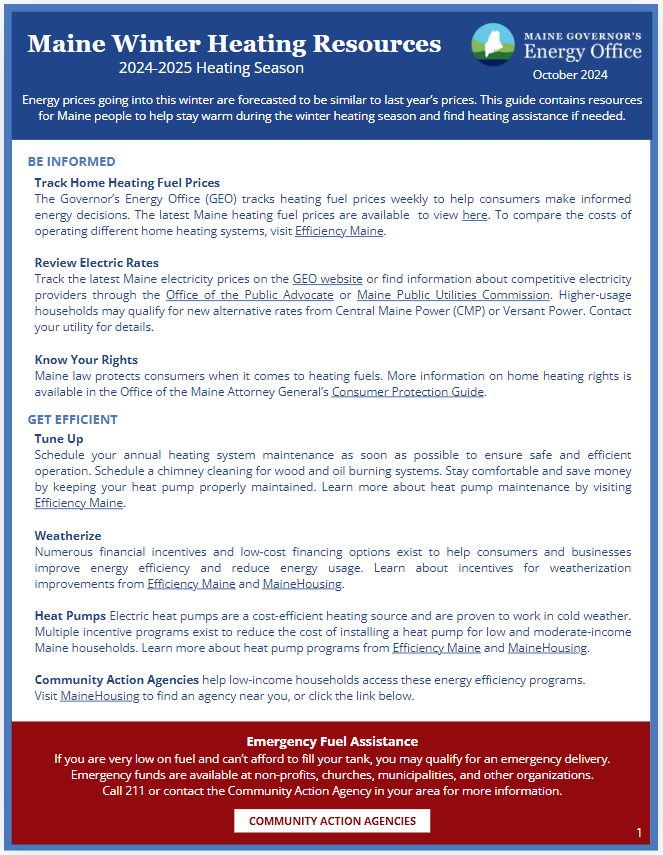
Maine Winter Heating Guide

The Governor’s Energy Office 2024 Winter Heating Guide contains resources for Maine people to help stay warm this winter and find heating assistance if needed. 


Download this Guide

Download our printable guide (PDF) for distribution in your community, agency or organization. 

Heating guide cover image

Prepare for Winter

  • Stay Informed: The Governor’s Energy Office tracks heating fuel prices to help consumers make informed energy decisions. The office has also shared a breakdown of heating fuel usage by type of fuel, updated October 2024 and available to download here.
  • Tune Up: Schedule your annual heating system maintenance as soon as possible to ensure it is operating most efficiently.
  • Energy Efficiency: Weatherizing your home and installing a high efficiency heat pump can help you save money this winter and use less fuel. Learn more about incentives and get energy saving tips from EfficiencyMaine and MaineHousing.
  • Lock Your Price: Some consumers may elect to lock a heating fuel price to have price predictability and guard against rising prices. If your dealer offers a contract, and you decide to lock in a price, please read the contract terms carefully and understand all parts of the contract before signing. Fixed-price contracts between a customer and dealer are binding once signed.
  • Automatic Delivery: Ask your heating fuel provider about automatic delivery. Your provider will monitor your fuel usage, so you won’t accidently run out of fuel. Automatic delivery also offers added security in the unlikely event of supply disruptions or very cold/inclement weather. 
  • Propane: If you heat with propane, read our Propane Consumer Guide (PDF), which includes information on obtaining a good price, changing suppliers and potential start-up fees.
  • Wood Heating: If you use wood to heat your home, read this firewood guide prepared by the Department of Agriculture, Conservation and Forestry.

Winter Energy Resources 

Home Energy Assistance Program (HEAP)Weatherization Assistance ProgramLow Income Assistance ProgramNatural Gas Customer DiscountsEnergy Efficiency InvestmentsElectricity Bill AssistanceCentral Heating Improvement ProgramMaineHousing’s Heat Pump ProgramMEMA’s Alternative Heat Source Safety GuideDIY Energy Efficiency Ideas


Energy Assistance Agencies

Governor’s Energy Office (GEO)MaineHousingEfficiency MainePublic Utilities Commission (PUC)Office of the Public Advocate (OPA)

Protect Your Donations During the Season of Giving

As the year winds down, many Americans embrace the ‘Season of Giving,’ and contribute to causes close to their hearts. In 2023, individual Americans gave a record $374.4 billion to charity, according to the Giving USA Foundation’s annual report on U.S. philanthropy. A significant portion of these donations occur in the final months of the year. While this surge in generosity supports many amazing organizations, it also creates opportunities for scammers to steal from well-meaning donors.
 
Here’s how to help make sure your money is getting to people in need and not the hands of criminals.
How It Works•
You get a phone call, an email, a direct mail piece, or even door-to-door solicitation collecting money for veterans, animals, children in need, victims of natural disasters, or other causes.•You may receive a “Thank you” email, letter, or phone call making you think that you have contributed to a particular cause in the past.•You feel pressured to contribute on the spot.
What You Should Know•
Sham charities also proliferate when big crises appear in the news — whether it’s war, famine, climate disaster, or other tragedies, all of which happen to be in abundance today.•Many fake charities have legitimate-looking names and websites, making them hard to discern as fraudulent.•While some charity scams are outright fake, others are registered nonprofits but devote little of the money they raise to the programs they raise funds for.•Legitimate charities are not going to ask for gift cards, wire transfers, or cryptocurrency as a form of payment and will not pressure you to contribute right away.
What You Should Do•
Research the charity on sites such as Give.orgCharityNavigator.org or CharityWatch.org to ensure its legitimacy and to find out how much of the donations are actually used to serve its stated mission versus overhead and fundraising.•Pay attention to the charity’s name and web address. Criminals often mimic the names of familiar, trusted organizations to deceive donors.•Be wary of links in unsolicited email, text, and social media fundraising messages; they can unleash malware on your device.•Don’t give personal and financial information like your Social Security number, date of birth, or bank account number to anyone soliciting a donation.•Use a credit card when making your contribution – it’s easier to keep track of it and, if your card is misused, you have protection from loss.

reprinted from AARP Fraud Watch Network

Food Assistance Resources

For those who need food assistance, the Maine Department of Agriculture and Forestry has a variety of resources available for Maine individuals and families. For those needing immediate direct food assistance, a searchable list of available Emergency Food Assistance Program resources can be found here or by calling 888-365-9287. Those families who are struggling to get by may be eligible for the Supplemental Nutrition Assistance Program (SNAP), which provides a monthly benefit to help low-income households purchase nutritious food. Visit the SNAP page for more information or apply directly through My Maine Connection. 211Maine also has links to resources for those seeking meal programs for both adults and youth. Dial 211 or visit the food page on their website for more information. If none of these resources is adequate, Good Shepard Food Bank of Maine works directly with over 600 organizations to help feed Mainers. Visit their Find Food map page for more information.