
9 Worst Habits for Your Liver

Everything from what you eat and drink to how much you move can affect the health of this vital organ
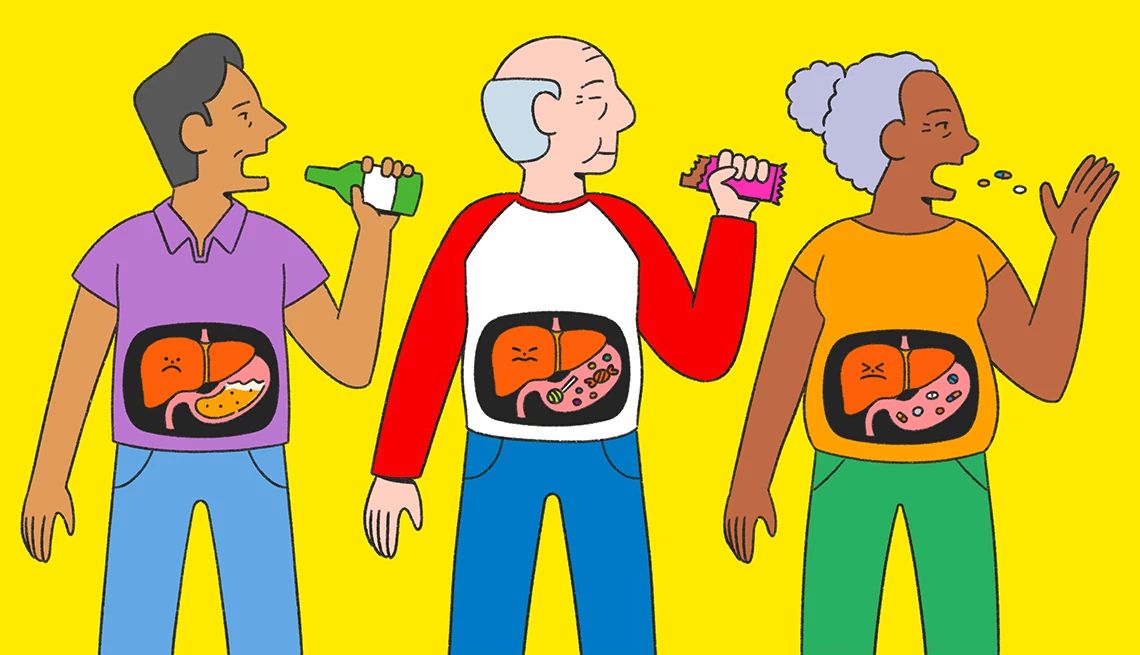
An illustration shows three older adults; one is consuming a beverage, another a sweet snack and another pills. The insides of their abdomens are shown, with progressively disappointed expressions.

If there’s one thing the liver is not, it’s lazy. This hardworking organ is involved in several essential jobs — from breaking down food and storing nutrients to filtering toxins from the blood and fighting infections — which is why keeping your liver in top shape is key to staying healthy as you age.

Still, many of us engage in everyday activities that can damage the liver over time. Here are nine habits that health experts say you should change for the sake of your liver.

1. Skipping your workout

The liver doesn’t want you to be sedentary. In fact, it loves exercise, says Elliot Tapper, M.D., an associate professor in the division of gastroenterology and hepatology at the University of Michigan Medical School — “and, in particular, resistance exercise,” he adds.

“Even people who don’t lose weight, when they start doing resistance exercise, the training of the muscles changes the way that hormones circulate,” he says, and this helps “drain fat” out of the liver.

A small study published in the journal Gut found that sedentary adults diagnosed with nonalcoholic fatty liver disease (which occurs when too much fat builds up in the organ) who did eight weeks of resistance exercise saw a 13 percent reduction in liver fat, independent of weight loss. They also saw improved markers of blood sugar regulation, which is another sign of improved liver health. 

That’s not to say you shouldn’t also be doing cardio. “Something that gets your heart pumping” benefits the liver, says James Hamilton, M.D., director of hepatology at Johns Hopkins Medicine.

“What we recommend generally is 30 minutes, five times a week, where you’re doing something where your heart is increasing in its output,” he says. “Even that, without weight loss, has been shown to reduce fatty liver and improve insulin resistance.”

In fact, an analysis of research published in The American Journal of Gastroenterology found that adults who participated in the recommended 150 minutes each week of moderate to intense aerobic activity, like a brisk walk, saw a greater improvement in liver fat than those who didn’t hit that mark.

2. Taking certain supplements

If you scroll social media long enough, you’ll no doubt encounter ads for supplements promising to heal your liver. Not so fast with the “buy now” button, doctors say.

“Your liver is like an automatic self-cleaning oven. It detoxifies by itself,” says Lisa Ganjhu, a gastroenterologist and hepatologist at NYU Langone Health. Take detoxifying supplements and you actually run the risk of injuring the organ.

“The supplements that give me a heart attack, that keep me up at night, are turmeric and green tea — and these are increasingly common,” Tapper says, emphasizing that the worry with these products is when they’re in supplement form and not as foods. 

In fact, research published in 2024 in the journal JAMA Network Open found that turmeric and green tea supplements were the most commonly consumed of six supplements associated with liver toxicity.  

Because supplements are not regulated by the Food and Drug Administration the same way other over-the-counter medications are, consumers don’t always know the ingredients in the bottle and the potency of these pills and powders, Hamilton explains. “And taking too much of it can potentially be toxic,” Ganjhu adds.

Most Popular

Health

It’s important to keep in mind that supplements can also interact with other medications you may be taking, and this can be hard on the liver “because everything goes through the liver,” Ganjhu says. This is why it’s key, she says, to keep your doctor up to date on all medications you are taking, including over-the-counter drugs and supplements.

3. Cutting out coffee  

Believe it or not, drinking coffee can be a boon for the liver, so don’t skip out on your morning cup — just be sure to hold the cream and sugar. A study published in 2022 in the journal Clinical Gastroenterology and Hepatology by Tapper and his colleagues found that individuals who drank three or more cups of coffee a day showed reduced liver stiffness, which is associated with liver disease.

Another study, published in the journal Cureus, found that people at higher risk for liver disease who drink at least three to four cups of coffee have a lower risk of developing nonalcoholic fatty liver disease (also called metabolic dysfunction-associated steatotic liver disease, or MASLD), which is an increasingly common condition that affects about 100 million people in the U.S.

According to experts at the Cleveland Clinic, the antioxidants found in coffee may be the reason it’s so good for the liver. It’s also thought that compounds in coffee help to initiate a process that removes damaged cells from the liver. 

Can’t handle the caffeine? Research published in BMC Public Health found that decaf comes with liver benefits as well.

4. Overindulging your sweet tooth

“The number one thing that the liver hates when it comes to food is sugar,” Tapper says — and especially high-fructose corn syrup, Ganjhu adds, which you’ll find in sweetened beverages, like juices and sodas, and processed snacks and desserts.

Not only is processing added sugar stressful on the liver, Tapper says, but the liver also turns the sugar into liver fat, which can lead to inflammation and scarring.

A meta-analysis of six studies, published in the European Journal of Nutrition in 2019, found that higher intake of sugar-sweetened beverages was associated with a 40 percent increased risk of fatty liver disease in both men and women. More recently, researchers from Mass General Brigham followed nearly 100,000 postmenopausal women and found that women who drank at least one sugar-sweetened beverage a day had a higher risk of developing liver cancer and dying from chronic liver disease than women who drank no more than three sugar-sweetened beverages a month. The study was published in 2023 in JAMA.

5. Drinking too much alcohol

This may not be a surprising addition to the list since alcohol’s effects on the liver are long established. But the science surrounding alcohol has changed in recent years, with many experts now saying no amount of alcohol is safe for human health.

“There’s never really a healthy amount of alcohol, and so less alcohol is always better, and you really want to keep under those seven drinks [per week] for a woman and 14 drinks [per week] for a man,” Hamilton says, citing the Centers for Disease Control and Prevention’s guidelines for moderate drinking.

However, there is good news for people who have been exceeding those guidelines: Cutting back your alcohol intake can partially improve the health of your liver, Tapper says. And, he adds, it’s never too late in life to cut it out completely and reverse liver damage.

“All of us who have practiced for several years have dozens of stories of people who thought that they were going to die from liver failure due to alcohol. They stopped drinking, and within a matter of months, their liver can heal all the way up to the point where nobody would ever know that they had liver failure months or weeks ago,” Tapper says.

reprinted from AARP.

Maine Dept of Motor Vehicles Scam

BMV TEXT SCAM: The Bureau of Motor Vehicles will never send you a text message with information about a potential suspension or unpaid infractions. Do not click on links in any unsolicited texts. If you were scammed, contact your financial institution immediately. If you are unsure if a message you have received is genuine, contact the BMV at 207-624-9000. 

15 Ways to Protect Yourself From Fraud

Scams are rampant these days, with criminals stealing a reported $12.5 billion from Americans in 2024, according to the Federal Trade Commission. And that’s likely a fraction of actual losses, because fraud is notoriously underreported. But there are ways to protect yourself, including staying up on the latest schemes and following the advice listed below. Also consider adding the AARP Fraud Watch Network Helpline phone number, 877-908-3360, into your phone right now, so you’ll have it if you need to call us to report a scam ­attempt or get more advice on how to prevent scams and identity theft.

1. Stop mail fraud at the mailbox

Informed Delivery is a free service from the U.S. Postal Service. The agency emails photos of letter-size mail expected to be delivered to you that day or shortly after. This is a great way to be sure that nothing is stolen from your mailbox by ID thieves. Sign up at InformedDelivery.usps.com.

Pick up mail as quickly as possible after it’s delivered, and always take your outgoing mail directly to the post office. A hot fraud now is scammers stealing checks from mailboxes, erasing the ink and using them to steal from bank accounts.

2. Halt scammers at your front door

Consider installing a video camera; they are increasingly less expensive, and they’re easy to install. If you don’t recognize a visitor, don’t answer. If you find yourself being pressured to buy or donate, have a refusal script ready (consider taping it near the door) that says, “I do not do business at my door. Please leave me something to review. If I’m interested, I’ll call you.”

Be wary of people posing as utility workers who show up unannounced. Don’t allow anyone into your house without an appointment.

3. Prevent garbage theft

Shred any papers that contain private information (financial statements, bills, shipping receipts) before putting them out for pickup to avoid identity theft. Don’t want to invest in a good cross-cut shredder? Many communities have shredding events or permanent drop-off sites. Get in the habit of dropping off your accumulated documents once every few months.

4. Watch for credit card skimming

Card skimming, in which the criminal affixes a credit card reader on top of a legitimate card reader at a store or gas station, is estimated to cause up to $1 billion in losses annually. When you are paying at a gas station or other point-of-sale location, inspect the device for loose/broken/scratched machinery to make sure someone hasn’t tampered with it. If you are unsure, notify the cashier and pay using an alternative method.​

5. Monitor your credit report

Routinely check yours (many credit card companies provide it for free; if not, go to AnnualCreditReport.com or call 877-322-8228). Watch for unusual activity; if you see any, report it immediately to the appropriate financial institution.

Then freeze your credit report. This prevents scammers from opening new credit cards or making big purchases in your name. You can unfreeze it as needed for legitimate transactions. Visit IdentityTheft.gov for more information.

6. Safeguard your wallet

Remove cards and information you don’t need to carry (such as your Social Security or Medicare card). Make copies of the remaining cards (front and back) and store in a safe place. 

Audit your wallet and purse frequently. Take out any unnecessary items that collect and could compromise your personal information if lost or that would be a hassle to replace.

7. Protect your financial accounts

Create online accounts with each of your financial institutions. Come up with a unique password for each, and every few months, revise the passwords. (Your best bet is to use a passphrase: Ilovemy­17dogz! is much stronger than Scruffy23. Keep track of passwords in a highly secure password manager or by writing them down and storing them safely.) But you should not rely solely on passwords. Many financial institutions will allow you to use a one-time passcode sent to your phone as an extra layer of security.

Then get in the habit of reviewing the transaction lists on a weekly or biweekly basis. Be sure you can account for every listed transaction. Spot something odd or incorrect? Immediately report it.

8. Safeguard your smartphone

If you have a newer model, turn on biometric identification (finger­print or facial recognition); this will help prevent a thief from logging in to your phone.

Send calls from unknown numbers to voicemail (you can enable this in the phone’s settings). Make sure your voicemail is set up and not full, so you can receive legitimate messages.

Scammers are sending far more bogus texts, often posing as companies you routinely deal with. Never respond to an unsolicited business text; if you think it might be valid, call the organization or go online.

Also make sure you are signed out of any ­financial apps on your phone — credit cards, financial institutions and peer-to-peer apps such as Venmo, CashApp or Zelle — when you aren’t using them.

9. Secure your computer

Turn on two-factor authentication for all secure websites you frequent, such as financial institutions or utility companies (find out how via each site’s online security center). Then only someone logged in to your phone can receive the code to access those accounts.

Consider subscribing to an antivirus software service. Some security experts say browsers and device manufacturers have more built-in malware protection than years ago, such as Microsoft Defender, which comes installed on some devices. Some paid subscriptions also include ad tracker blocking, cloud backups of your machines and identity theft monitoring.

10. Protect your email accounts

Actively designate unsolicited and unwanted email that shows up in your inbox as spam, so future emails from that site get blocked.

Do not open file attachments in emails from businesses or people you don’t trust completely. Malware is often planted via email attachments.

11. Set limits on social media

Set your profile so that only your friends can see your Facebook page. To do that, click the downward arrow button in the upper-right corner of your Facebook page, then click on Settings & Privacy and Privacy Checkup. This easy-to-use wizard will guide you through the settings. And never accept friend requests from people you don’t know or respond to random messages from strangers. But also note that impostor scams, where someone pretends to be your friend, are rampant on social media.

12. Verify online stores

To avoid shopping scams, when typing in a URL, double- and triple-check the spelling to ensure you are on the correct page. Scammers often create a URL with one letter off from the authentic one in hopes you won’t catch it.

Remove your credit card number and information from restaurant delivery and retail store sites. Pay using an e-payment service that keeps credit card info on a highly secure site.

13. Don’t pay for anything in gift cards, cryptocurrency or gold

It’s best to pay with a credit card, which can protect you from all sorts of scams — including gift card scams. Criminals prefer untraceable methods of payment that are hard to reverse, so will ask for gift cards, cryptocurrencygold bars, prepaid debit cards. If someone — especially a stranger — asks for payment or debt settlement using one of these payment methods, think twice. 

14. Find a sounding board

It’s a good idea to have at least one person who can help you identify potential scams by being a financial confidante — an objective party you can consult before making big purchases or money transfers to ensure that they’re wise and legitimate. And, as noted above, you also can call the toll-free AARP Fraud Watch Network Helpline at 877-908-3360 for advice, support and resources (available Monday through Friday, 8 a.m. to 8 p.m. ET).

15. Change the way you think 

Learn how to not engage. You are under no obligation in these modern times to respond to calls, emails or texts from strangers — especially given that so many of them are fraudulent. One option: Open your iPhone’s contact list and add your family, friends, doctors and other important numbers. Then go into your phone settings and turn on the setting for “silence unknown callers.” This will send any caller who isn’t in your contacts list directly to voicemail.

Learn to say no. Sometimes a caller will get through. Get tough: Say, “I do not do business over the phone. Goodbye.” Then hang up without remorse.

Trust your instincts. If something doesn’t sound right, run it by someone you trust and take extra time to think about it.

reprinted from AARP Fraud Watch Network.

Never sign anything in exchange for “free” services — it’s a scam

Beware of scammers, sometimes posing as salespeople, offering “free” services or gifts. They may be trying to trick you into signing up for hospice care without your knowledge. 

Heres how it works:

  1. Scammers text, call, email, post fake ads, or even knock on your door. 
  2. They offer “free” gifts or in-home perks, like cooking or cleaning services, protein shakes, medical equipment, or groceries.
  3. In exchange, they may ask for your Medicare Number and ask you to sign a paper.
  4. They’re tricking you into signing up for hospice care, so they can fraudulently bill Medicare for services in your name.

Remember: Never give out your Medicare Number and dont sign anything for free services — its a scam.

If you think you may have experienced fraud, call 1-800-MEDICARE (1-800-633-4227) or report it online at Medicare.gov/fraud.

Sincerely,

The Medicare Team

NOTE: Hospice care is for people who are terminally ill — and is a serious decision to be made only between you and your doctor.

More Ways to Help Protect Yourself From Fraud

According to the Federal Trade Commission, theft through fraud may have been as high as $158.3 billion in 2023 alone. That’s $434 million every day, or about $300,000 every minute, stolen from Americans by fraud criminals. To put this into perspective, if fraud were a U.S. company, it would rank in the top 40 by revenue.
 
Every one of us is a potential fraud target. But the good news is you can make yourself a harder one to reach.
 
In previous alerts, we shared tips like using strong passwords, enabling multi-factor authentication, checking your credit report, turning on auto-updates, ignoring unsolicited messages and shredding sensitive documents. Now, here are three more ways to safeguard your personal information.
Avoid Postal Theft•Criminals are stealing mail in search of checks, which they can alter or “wash” to steal money out of your account.•Collect your mail promptly after delivery and bring outgoing mail directly to the post office.
Bank Online•Though it may feel counterintuitive, online banking is actually safer in many ways.•You get 24/7 access to monitor your accounts and can set real-time alerts for activity.•Setting up online access yourself also helps block criminals from doing it with stolen identifying information.
Use Peer-to-Peer (P2P) Apps Safely•P2P apps like Venmo, Zelle and Cash App are convenient, but unlike credit cards, payments are instant and often irreversible.•Two common P2P-related scams are impersonation (relative in trouble and needs money quickly) and fake sellers on online marketplaces.•It’s safest to use them to transact with people you know and trust.

reprinted from AARP Fraud Watch Network

3 Big Risk Factors for Dementia to Avoid

While there are a few risk factors for dementia that you can’t control — like age and family history — a growing body of research shows that there are several that can potentially be changed throughout life. And a recent study suggests that three of these so-called modifiable risk factors may have a big impact on an aging brain.

Diabetes, alcohol consumption (measured by frequency) and exposure to air pollution are the most harmful modifiable risk factors for dementia out of 15 that were studied in a recent report published in the journal Nature Communications. A team of researchers examined brain scans of nearly 40,000 UK Biobank participants and found that parts of the brain associated with Alzheimer’s disease, the most common form of dementia, that are more prone to earlier and accelerated aging were most affected by these three factors.

“We know that a constellation of brain regions degenerates earlier in aging, and in this new study we have shown that these specific parts of the brain are most vulnerable to diabetes, traffic-related air pollution — increasingly a major player in dementia — and alcohol, of all the common risk factors for dementia,” study coauthor Gwenaëlle Douaud, an associate professor at the University of Oxford, said in a statement.

Other known modifiable risk factors studied were blood pressure, cholesterol, weight, smoking, depression, inflammation, hearing, sleep, socialization, diet, physical activity and education.

A closer look at the big three

The study findings are not surprising, says Andrew Bender, a neuroimaging researcher at the Cleveland Clinic Lou Ruvo Center for Brain Health. 

Excessive alcohol use — defined as more than 21 drinks weekly — is among the 12 modifiable risk factors for dementia noted in a 2020 report published by the Lancet Commission. The Centers for Disease Control and Prevention (CDC) says that over time, too much alcohol can lead to learning and memory problems, including dementia.

And Bender, who was not involved in the latest study, says “diabetes is a really well studied and well known risk factor.” If diabetes is not well controlled and too much sugar remains in the blood, it can damage the organs over time, including the brain, explains the Alzheimer’s Association. High blood sugar is also linked to inflammation and cardiovascular disease — both of which can contribute to declining brain health.

Research on the health effects of air pollution is newer, but has been accumulating in recent years. A 2023 study published in JAMA Internal Medicine looked at data from more than 27,000 adults older than 50 and found that those who went on to develop dementia were more likely to live in places with higher levels of fine particulate matter. This type of air pollution can come from vehicles and factories, though in this particular study, fine particulate matter from agriculture and wildfires was specifically associated with an increased risk of dementia.

Long-term exposure to wildfire smoke seems to be especially bad for brain health, according to a 2024 study published in the journal JAMA Neurology. A team of researchers analyzed the health care records of 1.2 million Southern California residents aged 60 and older and found that people who were exposed to higher levels of wildfire smoke had a greater risk of developing dementia.  

Another study published in 2024 in the journal Neurology found that people with greater exposure to traffic-related air pollution were more likely to have high levels of amyloid plaques in their brains after they died. These plaques are a hallmark of Alzheimer’s disease.

Inflammation could help explain the emerging link between air pollution and brain health. Some animal studies suggest that “there is a relationship between particulate matter in pollution and inflammation in the brain,” Bender says. Researchers have also found that tiny pollution particles — the kind you might inhale from smoke or exhaust in the air — can circulate in the blood and work their way into the brain, where they may cause direct damage. 

reprinted from AARP

Help Prevent Elder Financial Exploitation

The impact of elder financial abuse is profound. While it can come from known perpetrators like caregivers or family members, scams carried out by strangers are also a major threat. In fact, the Federal Trade Commission (FTC) estimated that fraud criminals stole as much as $61.5 billion from adults age 60 and over in 2023 alone.
 
World Elder Abuse Awareness Day is Ju‍ne 1‍5—a timely reminder that we can take steps to help prevent the financial exploitation of older adults. Here’s how.
Protect Financial Accounts•While it may seem counterintuitive, it’s actually safer to bank online. Not only does it give the account holder 24‍/7 access to review activity, but it also allows for real-time transaction alerts to monitor for suspicious activity. The other benefit is that a criminal can’t use illicitly acquired sensitive information to set up online access to the accounts.•Add a trusted contact to financial accounts. This person has no access to accounts or information about them; they are the point of contact if the account holder cannot be reached.
Monitor and Freeze Credit•Everyone, including older adults, should regularly check their credit reports for unauthorized activity. You can request free credit reports from each of the three credit reporting agencies—Equifax, Experian and TransUnion—at annualcreditreport.com.•You should also consider placing a credit freeze with each of the reporting agencies; this stops someone from using stolen credentials to open financial accounts.
Block Unwanted Calls and Text Messages•Check with your phone carrier or a trusted third party for free or low-cost call and text blocking services to keep the illegal robocalls and texts at bay.•Add all your numbers to the FTC’s Do Not Call Registry (donotcall.gov). It won’t stop scammers, but it will cut down on legitimate telemarketing calls and texts.

reprinted from AARP Fraud Watch Network.

Vacation Scams

The start of summer signals the start of travel season for many. But as you search for your next getaway, criminals are searching for their next opportunity to steal your money or sensitive information through fake listings, bogus deals and other schemes.
 
Before you book, take a moment to learn how to spot and avoid these common travel scams.
How It Works•You find a travel booking site offering exclusive vacation deals for far below market value.•Your rental car search lands you on a site offering fantastic deals.•You’re ready to book your stay using a vacation rental app, and the host asks you to pay outside the platform.
What You Should Know•Criminals create copycat travel sites that may appear toward the top of your search.•A fake vacation rental may have been stolen from real property listings and reposted with altered details.•If a host asks you to pay for your vacation rental outside the app you found the listing on, consider it a scam attempt.
What You Should Do•As in all other domains, a steeply discounted travel offer should be met with skepticism.•Avoid search terms like “cheap rental cars” that can draw more scam results.•Research a new-to-you travel site before booking by searching the company’s name along with the word “scam” or “complaint” or “review” to read about other people’s experiences.•Use a credit card to book travel — it offers stronger protections against fraud than other payment methods.

reprinted from AARP Fraud Watch Network

Toll Road Text Scams Are on the Rise

Summer is peak season for road trips—and scammers know it. As more people hit the highways, criminals are ramping up efforts to target drivers with fake toll charges aimed at stealing money and personal information.
 
Chances are you’ve already received a message about an unpaid toll that doesn’t ring a bell. According to the FBI, the scam started gaining traction last spring and has surged in recent months.
 
Here’s what to know about this trending scam.
How It Works•You receive a text or email appearing to be from a legitimate highway authority or a transponder company such as E-ZPass.•The message claims you have unpaid tolls, often for a small amount.•It urges you to click a link to pay the toll, warning that you’ll incur late fees if you fail to pay quickly.

What You Should Know•These messages are designed to be realistic (based on geography, for example), and the toll amount is typically small.•The scammers hope you’ll just click and pay without looking into whether you actually have an unpaid toll.•Their goal is to steal money and payment information or to infect your device with malicious software that could lead to financial loss and identity fraud.

What You Should Do•If you get a message about unpaid tolls, do not respond or click on any links.•Instead, check your account using the state tolling agency or transponder company’s legitimate website or phone number—not information from the message.•If your smartphone has a “report junk” option, use it to flag the message for your carrier.•If you have been victimized by a toll scam, report it to local law enforcement and the FBI’s Internet Crime Complaint Center, IC3.gov.

reprinted from AARP Fraud Watch Network.

Trending Scams

Toll ScamsWhats trending

Scammers are sending out emails and/or texts acting as toll companies and advising of an unpaid toll. The messages often include a link taking the recipient to a screen where they’re asked to enter their card information which the scammer may use to provision the card with a mobile wallet provider.

Red Flag: You’re being pressured to click on a link and provide information which the scammer may use to steal your money.

Social media-based investment scams

Be aware of “buy this stock – get rich quick” schemes via social media. Scammers may send you a link containing malware that allows them to get enough information so they can access your account or open a new one in your name. The scammer may place multiple trades in an investment account to “pump” up the price of a thinly traded stock. Then, they “dump” shares of the stock by selling their own shares at the inflated price before selling the stock at a loss in the ID theft/ATO account.

Red Flag: If someone on social media unexpectedly contacts you about a “get rich quick” scheme that sounds too good to be true, it probably is.

Real Estate and Vehicle Scams

Scammers may misrepresent a large purchase such as property, lease or a vehicle to trick you into sending them money. They’ll often copy the descriptions of online listings and replace the agent’s contact information with their own.

Red Flag: You’re asked to pay in less common ways such as wire transfers, gift cards for a property or vehicle rental or purchase. Research the listing; look at the URL and domain name to make sure that you’re not on a fake site.

Pause. Verify. Help prevent scams.

  1. Pause. Don’t let anyone rush you into a decision, especially if it involves money or sharing personal information or codes. Take time to evaluate any requests especially if asked to pay in less common ways.
  2. Verify. Confirm who the person really is. Does the story or request make sense? Contact the supposed family member, organization or bank using a phone number you trust, such as a number from a statement or the back of your card. You can’t always trust numbers found online.
  3. Help prevent scams. Know what to look for. Keep up with scammers’ latest tactics and talk to friends and family about scams so they can help protect themselves.

Know how to spot an imposter

Imposters may pose as a trusted figure. They claim there’s an issue and urge you to act quickly to resolve it.

What to watch out for:

  1. Initial Contact: Scammers may reach out through various methods (social media, text, email, phone call, computer pop-up) and may claim:
    • There’s fraud on your account, and you need to move or withdraw your money
    • They’re an online romantic interest who needs money to resolve a crisis
    • It’s the IRS and you have an unexpected overdue tax payment or are owed taxes
    • There was a failed package delivery attempt
    • Your computer has an issue that they can help fix
    • A job application needs personal details, like Social Security number, account number or PIN
    • There’s an unexpected monthly fee for financial aid or tuition reimbursement
    • A company you do business with is providing a refund for overpayment
  2. Deceptive instructions: If they tell you to do any of the following, pause and ask yourself, “Does what they’re asking make sense?”
    • Withdraw cash and deposit it into your “new” account (which they provide the number for) via ATM, or in a digital currency ATM, like Bitcoin
    • Move money to your digital wallet and then move it to your “new” account number to resolve fraud
    • Click a link or download an attachment to provide your payment information
    • Share your personal identification number (PIN) or security code
    • Ignore warning messages as you follow their instructions
    • Say the bank is “in on” the fraud
    • Provide remote access to a device or download an app
    • Type a code into your device beginning with special characters (such as *72 or **21)
  3. The scammer wins: If you follow their instructions
    • You’ll have moved your money into the scammer’s account (not your “new” account) where it’s unlikely to be recovered
    • The scammer can use your personal and financial information to steal your money
    • They may install malware on your devices to steal information
    • Your incoming calls and texts may forward to the scammer if you typed *72 or **21 plus a number into your phone
    • They may demand money to restore access to your accounts or devices or to stop them from releasing your personal information
  4. Bank of America will never ask you to move or withdraw money or pay anyone, including yourself.
  5. Never ignore scam warnings, even if you’re told to do so.
  6. Verify any requests for money through legitimate sources.
  7. Don’t open unfamiliar links for payment or personal information.
  8. Be cautious about granting device access or downloading unfamiliar apps to fix issues. Run a full system virus and spyware scan and power off your device.

Check out layer more examples of scams and tips to help you be more secure

Know the red flags that signal a scam

Scammers are constantly reinventing new ways to trick people. While their stories may change, their tactics remain the same. Being aware of these red flags should make you pause, verify, and help stay protected:

Read how to stay safe from Cybercrime layerYou’re contacted out the blueYou’re pressured to act immediatelyYou’re asked to pay in unusual wayYou’re asked to provide personal or account informationIt seems too good to be true

If you authorize a transfer or send money to a scammer, there’s often little we can do to help get your money back.

Read our tip sheet on talking to friends and family about fraud, scams and cyber security.

Parents, Caregivers and Older Adults

Learn how scammers may target those you love.

Parents

  • Review a quick infographic with your kids to teach them about how they can help avoid being scammed
  • Read how you can help protect young adults in your life from scams

Caregivers and Older Adults

Check out the resources below that can help protect you and the loved ones from Fraud and Scams

Additional Resources

 Best practices when using QR codes or clicking on links